go-service
🌐 Transport
The transport layer provides higher-level wiring and middleware policy for communication in/out of the service.
At a high level:
transport/...contains the opinionated service transport layer: Fx wiring, composed HTTP/gRPC server and client stacks, retries, breakers, token middleware, health wiring, and related policy.net/...contains lower-level protocol helpers and reusable primitives such asnet/http,net/grpc,net/http/meta,net/grpc/meta,net/grpc/health,net/header, andnet/server.
Supported stacks include:
- gRPC (https://grpc.io/)
- HTTP REST abstraction (
net/http/rest) using content negotiation - HTTP RPC abstraction (
net/http/rpc) using content negotiation - HTTP MVC helpers (
net/http/mvc) - CloudEvents (https://github.com/cloudevents/sdk-go)
CloudEvents HTTP wiring lives under transport/http/events: use
NewReceiver(...).Register(...) to receive events on a POST route and
NewSender(...).Send(...) with net/http/events.ContextWithTarget(...) to
send events. The sender uses structured HTTP encoding by default; configure
WithSenderEncoding(SenderEncodingBinary) for outbound integrations that
require binary-mode CloudEvents. Webhook-protected receivers require structured
encoding and reject binary-mode CloudEvents with ce-* headers before
signature verification. Receiver registration marks the event route as
unauthenticated for transport token/access middleware so webhook verification can
act as the event authentication boundary.
Token and access-control configuration is documented separately in Tokens.
HTTP content types
The HTTP REST and RPC helpers decode request bodies from the request Content-Type, falling back to JSON when Content-Type is absent. An unparseable, unregistered, or intentionally undecodable Content-Type is rejected with HTTP 415 rather than falling back to JSON. Response encoding uses the first Accept media type when present, falling back to the request Content-Type when Accept is absent. Client helpers can set ContentType for the request body and Accept for an independent response format.
Built-in text/object payload media types include:
application/jsonapplication/hjsonapplication/yamlapplication/tomlapplication/octet-stream,text/plain
Internal binary payload media types include:
application/vnd.msgpackapplication/gob
Built-in protobuf-oriented media type aliases include:
application/proto,application/pb,application/protobuf,application/protobin,application/pbbinapplication/protojson,application/pbjsonapplication/prototext,application/prototxt,application/pbtxt
[!NOTE]
application/hjsonmaps to the built-inhjsonencoder kind.- Unknown or invalid media types fall back to JSON selection only for outbound (
Accept-driven) negotiation. An absent requestContent-Typestill defaults to JSON, but an unknown or invalid one is rejected with HTTP 415 rather than decoded as a different format than the caller declared.text/erroris reserved for error responses and should not be sent by clients as a request content type.
application/toml,application/vnd.msgpack, andapplication/gobcan be resolved as media types and remain valid response codecs, but REST/RPC request-body decoding — for both single-value and streaming (NDJSON) requests — rejects them with HTTP 415. This follows the decoder-bounds rule documented innet/http/content/unary’s package documentation: a codec is admissible for decoding untrusted input only when it is both ratio-bounded and depth-bounded, which TOML, msgpack, and gob are not.
HTTP streaming (NDJSON)
REST and RPC support streaming routes alongside the single-value helpers above, for responses (and, over HTTP/2, requests) that arrive as a sequence of values instead of one buffered payload:
| single-value | streaming | direction | HTTP/2 required |
|---|---|---|---|
rest.Server.Get/rest.Server.Route |
rest.Server.StreamGet/rest.Server.StreamRoute |
send-only | no |
rest.Server.Post/rest.Server.Put/rest.Server.Patch/rest.Server.RouteRequest |
rest.Server.StreamPost/rest.Server.StreamPut/rest.Server.StreamPatch/rest.Server.StreamRouteRequest |
bidirectional | yes |
rpc.Server.Route |
rpc.Server.StreamRoute |
bidirectional | yes |
A send-only streaming handler gets a *stream.Stream[Res] with Send; a bidirectional streaming
handler gets a *stream.RequestStream[Req, Res] with both Send and Recv. Client calls use the
matching client.Stream/client.RequestStream functions, which take the same kind of callback.
See net/http/client’s ExampleClient_RequestStream for a complete HTTP/2 bidirectional client call.
HTTP route policy
Register a raw HTTP handler with http.Router.HandleRoute and compose its policy in the same call:
router.HandleRoute(
	"GET /feed",
	handler,
	http.WithRouteOperation(),
	http.WithRouteUnauthenticated(),
)
[!WARNING]
http.WithRouteOperationis for service-owned infrastructure paths, such as the health and metrics routes. Operation matching is path-only, so it marks the pattern’s path for every method — markingGET /feedalso marks a separately registeredPOST /feed— and supported middleware treats an operation route as exempt from token verification, access control, and rate limiting, and omits its per-request outcome log line.http.WithRouteUnauthenticatedinstead bypasses transport token verification and access control while retaining rate limiting and normal outcome logging; use it only when another boundary protects the route.
REST and RPC route helpers accept HTTP route options. Streaming helpers add their inherent stream direction,
and supplied streaming options are additive. MVC accepts only mvc.WithRouteUnauthenticated for its view routes.
MVC static helpers keep their StaticOption signature; use
mvc.WithStaticUnauthenticated() to opt a static route out of authentication.
[!IMPORTANT] Route policy registration now happens only through
HandleRoute. This intentionally removes the previousRouter.Handle*and mutatingRoutePolicyregistration APIs from v2. MigrateRouter.HandletoHandleRoutewithout options, and migrate specialized registration toHandleRoutewith the correspondingWithRoute*option. ReplaceIsStreamingchecks with the separateIsRequestStreamingandIsResponseStreamingchecks.
[!IMPORTANT] Single-value helpers live in
github.com/alexfalkowski/go-service/v2/net/http/content/unary; streaming helpers live ingithub.com/alexfalkowski/go-service/v2/net/http/content/stream. ImportunaryforContent,Media,NewContent,NewHandler, andNewRequestHandler; importstreamfor incremental request/response helpers.stream.NewHandlerandstream.NewRequestHandlertake*stream.Content, while unary handlers take*unary.Content.rest.NewServer,rpc.NewServer, andclient.NewClienttake the unary and streaming content owners separately. Migrate rootcontentimports and identifiers tocontent/unaryandunary, respectively; usenet/http.ContentTypeKeyandnet/http.AcceptKeyfor the shared header names.
The initial wire format is NDJSON (application/x-ndjson), newline-delimited JSON values, resolved
through a separate streaming encoder/decoder registry (encoding/stream.Map) from the single-value one
above — an unregistered or unparseable streaming media type is rejected outright rather than falling
back to JSON, unlike single-value negotiation.
[!NOTE]
- Bidirectional streaming routes require HTTP/2 (including h2c); a request over HTTP/1.x is rejected with
505 HTTP Version Not Supportedbefore the handler runs. Send-only streaming routes have no such requirement and stay fully supported on HTTP/1.1 chunked responses.- A
HEADrequest to a send-only streaming route (matched by the same mux pattern asGET) gets the negotiated response headers with an implicit 200; the stream handler itself is never invoked.- Streaming responses are not gzip-compressed, regardless of the client’s
Accept-Encoding.max_receive_sizeapplies per decoded value on a streaming request body, not as a cumulative total across the whole stream; overall stream volume is controlled by the configured rate limiter instead, which charges one token per streamed message in addition to the token charged when the stream opens.- A successful
Sendextends the HTTP server’s configured write timeout, and on a bidirectional stream a successfulRecvextends both the read and write timeouts (andSendextends both too), so a slow-but-active stream is not severed by a whole-stream deadline in either direction; bound a client-side streaming call with the request context instead of the client’s overall request timeout.- The per-message read/write timeouts follow the same
options.read_timeout/options.write_timeoutprecedence as the server’s own timeouts (see Transport configuration (servers)), falling back to30swhen the corresponding option is unset.- Streaming requests are never retried by the client’s retry middleware.
- A stream failure after the response has committed is recorded as a trace error and in the access log, then aborts the response so clients do not receive a clean but truncated stream. The upstream HTTP server RED metrics do not record aborted streams; use the access log to investigate that failure class.
- During standard server shutdown, stream handler contexts are canceled. Handlers must return after
ctx.Done()when waiting on an upstream source; an activeRecvends with the drain signal. A blockedSendremains subject to the configured write timeout. If the lifecycle shutdown deadline expires, the server force-closes remaining HTTP connections, so clients observe a transport error. A bidirectional HTTP/2 client may observe the forced request-body close as a stream reset and should reconnect to a non-draining server.
HTTP route misses
The HTTP transport wraps the mux with net/http.NewNotFoundHandler so generated 404 responses can be rendered consistently while preserving other mux responses such as 405 Method Not Allowed.
- REST/RPC-style missing routes use
net/http/status.NotFoundHandler, which writes the standardstatus.WriteErrorresponse. - MVC missing routes can use
mvc.Server.NotFoundHandlerto render the registered MVC not-found view when the request accepts HTML (Accept: text/html) or is an HTMX request (Hx-Request: true). - Routes that match and write their own status are not replaced by this mux-level not-found handler.
HTTP MVC errors
When an MVC controller returns an error, mvc.Server.Route renders the returned view with a client-safe mvc.Error model. The model contains the HTTP status Code and safe client-visible Message.
The raw error string remains available to templates as mvcModelError metadata for compatibility. Rendering that metadata can expose diagnostic details, so prefer .Model.Message for client-visible error pages.
Transport configuration (servers)
Transport config root is transport.Config:
transport.httpandtransport.grpcembedconfig/server.Configand own their unarytimeoutfields.
Minimal example:
transport:
  http:
    address: tcp://localhost:8000
    timeout: 10s
  grpc:
    address: tcp://localhost:9000
    timeout: 10s
[!NOTE]
- Address may use
<network>://<address>(for exampletcp://:8000) or a raw listen address such as:8000, which defaults to thetcpnetwork.- If address is omitted, defaults are
tcp://:8080(HTTP) andtcp://:9090(gRPC).- A
transport.httportransport.grpcblock enables that transport even when onlytimeoutis set; omit the block entirely to disable it.transport.http.timeoutbounds non-streaming handler contexts andtransport.grpc.timeoutbounds unary RPC handlers. Both default to30sand do not cap stream lifetime; long-lived HTTP and gRPC streams remain governed by client cancellation and their stream-specific controls.- During gRPC shutdown,
GracefulStopwaits for active handlers but does not cancel a stream handler context or interrupt an in-progressRecv. Stream handlers that must finish within the lifecycle stop deadline need a bounded or application-owned cancellation workflow; otherwise the lifecycle force-stops the server at that deadline and clients observe a transport error.- HTTP socket deadlines and streaming read/write inactivity budgets are controlled by
transport.http.options.read_timeout,write_timeout,idle_timeout, andread_header_timeout, each of which defaults independently to30s. gRPC connection and keepalive lifetimes are controlled bytransport.grpc.optionsand retain their documented lower-level defaults when unset.- For gRPC keepalives,
keepalive_ping_timeis the interval between heartbeats andkeepalive_ping_timeoutis the maximum wait for a heartbeat acknowledgement.- gRPC limits each client connection to 64 concurrent streams by default. Set
transport.grpc.options.max_concurrent_streamsto a positive base-10 integer to override it, or to"0"to explicitly retain upstream’s unbounded behavior.- HTTP/2 tuning is opt-in through
transport.http.options:http2_max_concurrent_streamsis a base-10uint32count (with"0"retaining the Go default), whilehttp2_max_receive_buffer_per_connectionandhttp2_max_receive_buffer_per_streamare size strings. The connection buffer must be at least65535B; the stream buffer must be at least1B. Both are capped atmath.MaxInt32(2147483647B). Zero or out-of-range buffer values fall back to Go’s HTTP/2 default of1048576B(1MB).max_receive_sizelimits inbound payload size. A zero value uses the default4MB.- For HTTP,
max_receive_sizeapplies per request body, except for bidirectional streaming routes (see HTTP streaming (NDJSON)), where it applies per decoded value instead, with no cumulative total. For gRPC, it applies per inbound unary request and per inbound stream message.- MVC does not enforce its own body-size caps; supported HTTP server wiring applies
max_receive_sizebefore MVC handlers run, and go-service HTTP clients apply their configured response-size cap when reading responses.
Receive-limit example:
transport:
  http:
    max_receive_size: 2MB
  grpc:
    max_receive_size: 3MB
With low-level server options:
transport:
  http:
    address: tcp://localhost:8000
    timeout: 10s
    options:
      read_timeout: 10s
      write_timeout: 10s
      idle_timeout: 10s
      read_header_timeout: 10s
      http2_max_concurrent_streams: "128"
      http2_max_receive_buffer_per_connection: 1MB
      http2_max_receive_buffer_per_stream: 512KB
  grpc:
    address: tcp://localhost:9000
    timeout: 10s
    options:
      keepalive_enforcement_policy_ping_min_time: 10s
      keepalive_max_connection_idle: 10s
      keepalive_max_connection_age: 10s
      keepalive_max_connection_age_grace: 10s
      keepalive_ping_time: 10s
      keepalive_ping_timeout: 10s
TLS for transports
TLS config uses crypto/tls/config.Config and fields are source strings:
transport:
  http:
    tls:
      cert: file:test/certs/cert.pem
      key: file:test/certs/key.pem
      ca: file:test/certs/rootCA.pem
  grpc:
    tls:
      cert: file:test/certs/cert.pem
      key: file:test/certs/key.pem
      ca: file:test/certs/rootCA.pem
Set ca on server TLS config to require and verify client certificates for mTLS. Set ca on client TLS
config to verify server certificates issued by the same local or private CA. server_name is only needed
on clients when the dial address differs from the certificate DNS name.
Server-side TLS requires a complete cert and key pair whenever TLS material is configured. ca enables
client-certificate verification for mTLS, but a CA-only server TLS config fails startup.
Runtime servers require TLS 1.3 or newer on inbound handshakes; clients keep a TLS 1.2 floor so outbound calls stay interoperable with TLS-1.2-only endpoints.
gRPC clients use insecure transport credentials when TLS is not configured. That default is intended for local or platform-secured traffic; configure client TLS for calls outside that trusted boundary.
[!IMPORTANT] If you are using
go-service-templateor composing server transport bundles such asmodule.Serverortransport.Module, the required transport registration is handled for you by DI.
module.Clientdoes not wire transports by default. When a client process constructs HTTP or gRPC TLS config from source strings such asfile:, call the relevant transport-levelRegister(...)functions, such astransport/http.Register(...)ortransport/grpc.Register(...).You only need to call transport-level
Register(...)functions yourself when you intentionally wire transports manually or compose lower-level packages outside the transport module graph.If you are wiring server lifecycle manually, use
net/server.Register(...).
Forwarded IPs and reflection
[!WARNING] HTTP and gRPC metadata extraction intentionally trusts common forwarded IP headers/metadata such as
X-Forwarded-For,X-Real-IP,CF-Connecting-IP, andTrue-Client-IP. Services that rely on extracted IPs for logging, policy, or rate limiting should only receive traffic through trusted edge infrastructure that strips or overwrites client-supplied forwarding headers.
[!WARNING] gRPC server reflection is intentionally always registered by
net/grpc.NewServerso internal tooling can discover services. Services that should not expose reflection publicly should restrict access with bind addresses, TLS/client authentication, ingress policy, firewall rules, or service-mesh authorization.
Dependencies
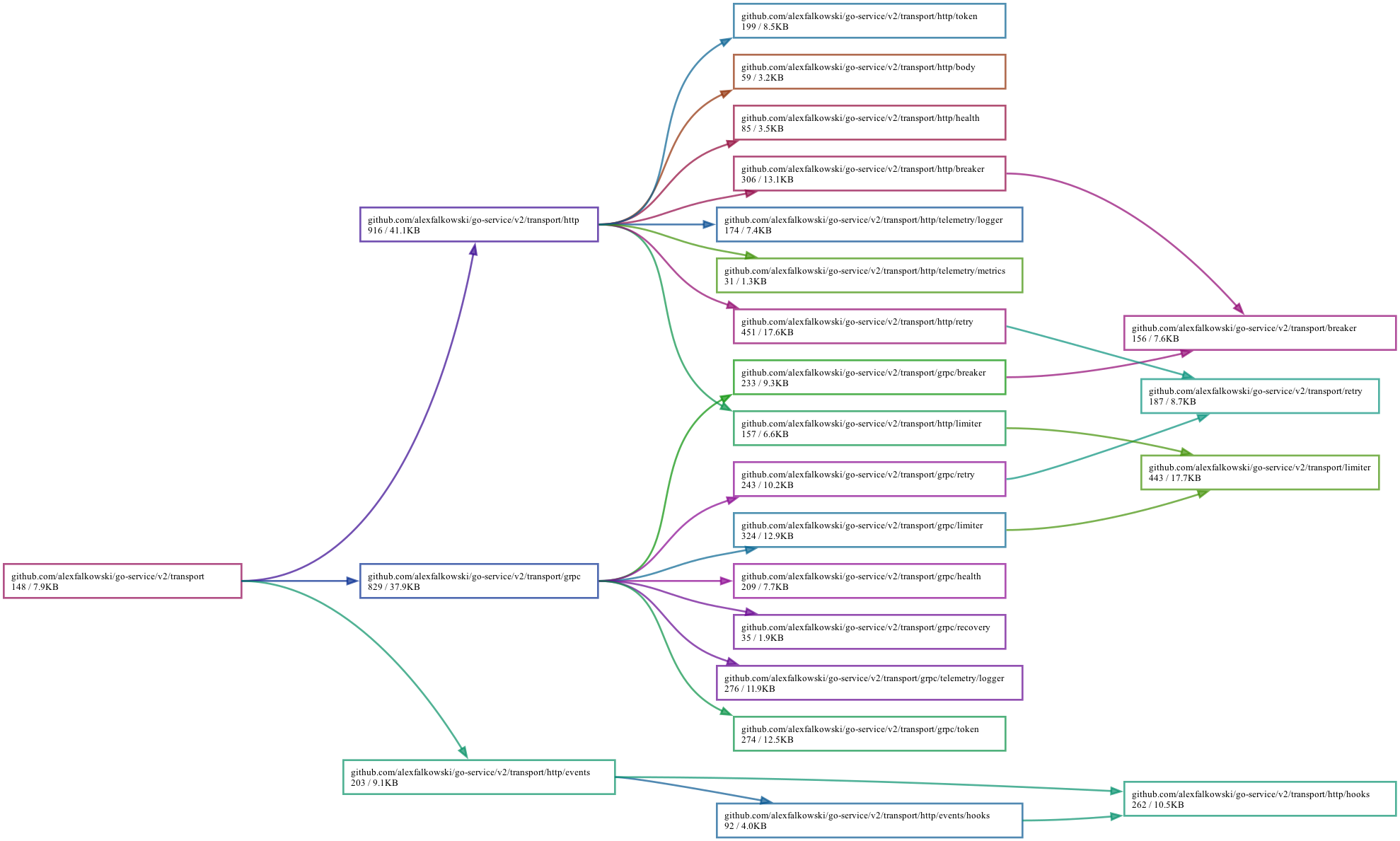
Circuit breakers (client-side)
The transport client wrappers include optional circuit breakers:
- HTTP breaker (
transport/http/breaker):- Scope is per
"<METHOD> <HOST>". - Default failure statuses are
>=500and429. - Requests with an already deadline-exceeded context bypass breaker accounting.
- Transport errors are counted as failures.
- Failure status responses are still returned to callers (while breaker accounting records a failure).
- Scope is per
- gRPC breaker (
transport/grpc/breaker):- Scope is per
fullMethod. - Default failure codes are
Unavailable,DeadlineExceeded,ResourceExhausted, andInternal. - Errors with other gRPC codes are treated as successful for breaker accounting.
- Scope is per
Client config uses the shared transport/breaker.Config shape for breaker mechanics. Any config type that
embeds config/client.Config has its own breaker block under that client config. This example uses
feature.Config only because it is one such client config:
feature:
  address: localhost:9000
  breaker:
    max_requests: 2
    interval: 15s
    timeout: 5s
    consecutive_failures: 4
When manually constructing HTTP or gRPC clients, pass a transport-specific breaker config to
transport/http.WithClientBreaker(...) or transport/grpc.WithClientBreaker(...). These configs
embed the shared breaker mechanics and add protocol-specific failure classification:
httpBreaker := httpbreaker.NewConfig(sharedBreaker, 429, 502, 503)
grpcBreaker := grpcbreaker.NewConfig(sharedBreaker, codes.Unavailable, codes.ResourceExhausted)
NewConfig returns nil when the shared breaker config is nil, preserving client-option wiring that
disables breakers by omitting breaker config.
max_requests controls half-open probe concurrency. interval controls the
closed-state count reset window. timeout controls how long the breaker stays
open before allowing half-open probes. consecutive_failures controls when the
breaker opens. Zero values keep the package defaults.
Instead of (or alongside) consecutive_failures, failure_ratio and
min_requests open the breaker on a sustained error rate rather than an
unbroken run of failures:
feature:
  address: localhost:9000
  breaker:
    failure_ratio: 0.5
    min_requests: 10
failure_ratio is the fraction of failed requests (0 < r <= 1) within the
current interval that opens the breaker, evaluated only once min_requests
requests have been observed. When failure_ratio is set, it takes precedence
over consecutive_failures.
HTTP StatusCodes and gRPC Codes are optional replacement lists for failure
classification. When omitted, the default lists above apply. When set, only the
configured values count as breaker failures, so include the defaults as well
when extending rather than replacing default behavior.
Client retries
Client config uses the shared transport/retry.Config shape for retry mechanics. Any config type that embeds
config/client.Config has its own retry block under that client config. This example uses feature.Config
only because it is one such client config:
feature:
  address: localhost:9000
  retry:
    timeout: 1s
    backoff: 100ms
    attempts: 3
    strategy: exponential
When manually constructing HTTP or gRPC clients, pass a transport-specific retry config to
transport/http.WithClientRetry(...) or transport/grpc.WithClientRetry(...). These configs embed the
shared retry mechanics and add protocol-specific failure classification:
httpRetry := httpretry.NewConfig(sharedRetry, 429, 502, 503)
grpcRetry := grpcretry.NewConfig(sharedRetry, codes.Unavailable, codes.ResourceExhausted)
NewConfig returns nil when the shared retry config is nil, preserving client-option wiring that
disables retries by omitting retry config.
attempts is the total number of attempts, including the initial call. A value
of 0 or 1 means no retry beyond the first attempt; values above 10 are
rejected during config validation. backoff is the base delay between retry
attempts.
strategy selects how backoff grows between attempts: constant (the
default) reuses the base delay for every wait, exponential doubles it on each
attempt, and fibonacci grows it along the Fibonacci sequence. An unset value
applies constant, jitter is applied on top of the chosen strategy, and any
other value is rejected during config validation.
timeout is transport-specific. gRPC unary retries apply it per attempt, so
total elapsed time can include multiple attempt timeouts plus backoff unless the
caller context ends first. HTTP retries do not create a retry-owned per-attempt
timeout; bound outbound HTTP calls with the request context or
http.Client.Timeout.
max_backoff caps the per-attempt backoff duration, applied before jitter. It
is most useful with exponential and fibonacci growth, which otherwise grow
unbounded across attempts. A zero value (the default) leaves backoff
uncapped:
feature:
  address: localhost:9000
  retry:
    backoff: 1s
    strategy: exponential
    attempts: 10
    max_backoff: 30s
HTTP StatusCodes and gRPC Codes are optional replacement lists for failure
classification. When omitted, the default lists below apply. When set, only the
configured values are retryable, so include the defaults as well when extending
rather than replacing default behavior. HTTP values must be 4xx or 5xx status
codes. gRPC values must be non-OK codes.Code values.
Default retry policy is intentionally conservative:
- HTTP retries side-effect-safe methods (
GET,HEAD,OPTIONS) or requests with aRequest-Id. - HTTP retries response/status failures only for
429 Too Many Requestsand503 Service Unavailable, plus selected transport errors classified byretryablehttp.DefaultRetryPolicy. - gRPC retries AIP-style read methods named
Get*orList*, or calls with aRequest-Id. - gRPC retries only
Unavailableby default.
HTTP retryable responses with a valid Retry-After delay greater than the
minimum jittered backoff suppress another attempt and return the current
response. gRPC retryable status errors with google.rpc RetryInfo.retry_delay
use the same suppression policy.
Request-Id identifies the logical request, not an individual wire attempt.
Services that allow retried writes should treat it as the idempotency key and
deduplicate repeated attempts when duplicate processing would be unsafe.